Aptos: The Full Stack for Markets and Machines
Aptos Foundation and Aptos Labs are committing over $50 million across the stack spanning funding for first-party products, research, protocol infrastructure, and a strategic fund for trading and AI partners.
Most chains are optimizing for attention. Aptos has been optimizing for the two fields that will define the next decade of onchain activity: markets that demand institutional-grade execution, and autonomous systems transacting at machine speed.
For most of the network's history, the technology was ahead of the demand. Aptos shipped infrastructure built for billions of transactions before the use cases that needed that scale existed. That demand is now arriving, and the full force of the ecosystem is pointed at serving it.
Decibel is live on Aptos mainnet, bringing that standard to trading. Shelby is bringing it to data. They're early. The infrastructure is not.
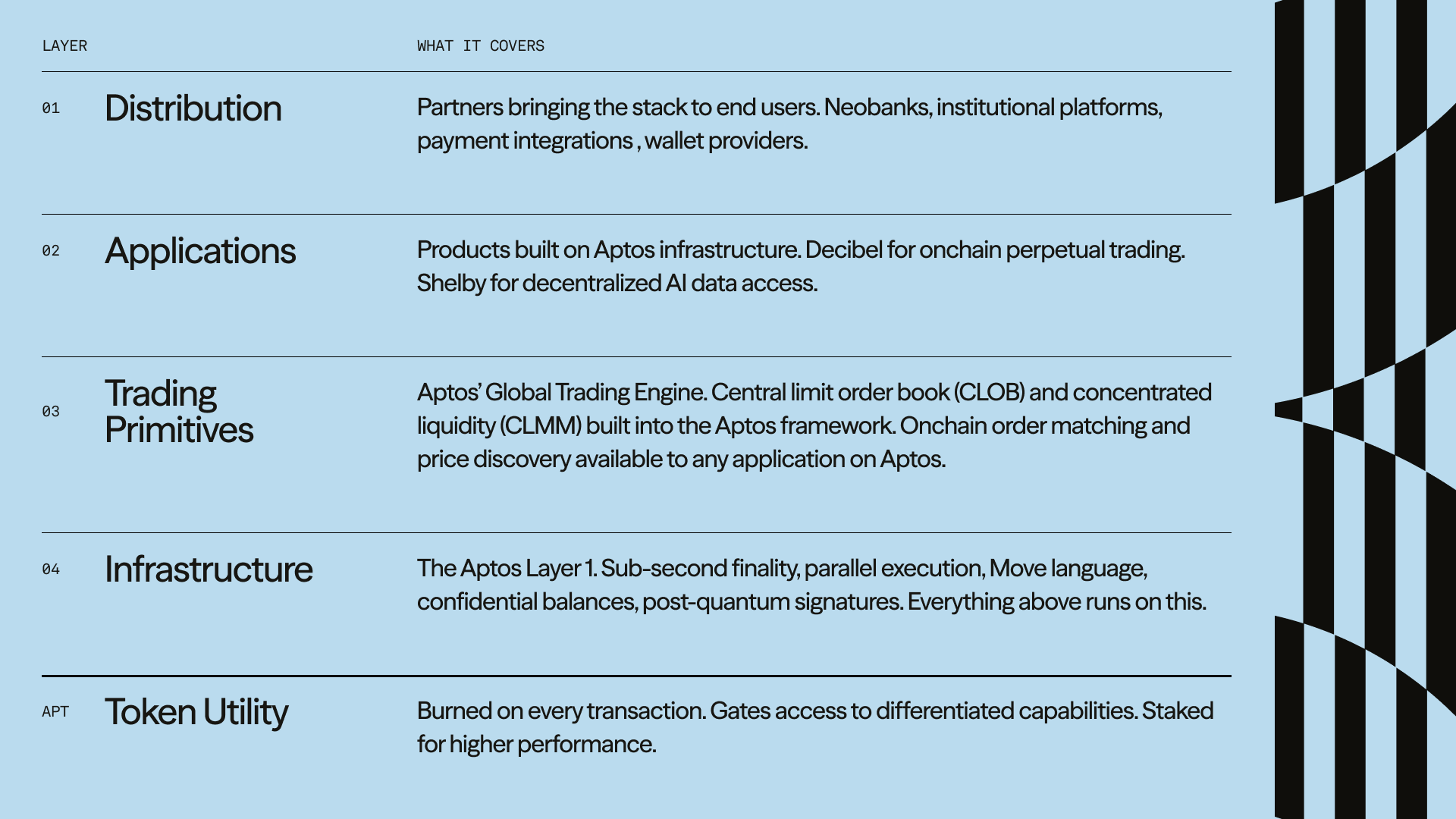
The Aptos Stack
The Aptos stack spans everything between the Layer 1 and the end user. Each piece solves a distinct problem for markets or machines, with APT as the asset that ties access, performance, and supply economics to the layers below.
Why now, and why Aptos
Five things are true about Aptos today that aren't true about any other chain at the same time. These are what's already live, not what's coming.
-
Technology. Sub-second finality, parallel execution, and the lowest transaction fees of any major chain.
-
Security. Aptos is built on Move, a language designed so that whole categories of exploits can't compile in the first place. Asset duplication, reentrancy drains, and unauthorized access don't make it past the build step, let alone into production. On top of that, post-quantum signatures are already live, on NIST standards, with no hard fork required, a migration most chains haven't started.
-
Policy. APT is classified as a digital commodity by both SEC and CFTC staff, a regulatory conclusion most chains cannot claim and cannot manufacture. Aptos Labs CEO Avery Ching has testified before Congress and sits on the CFTC Global Advisory Committee's Digital Asset Markets Subcommittee. As the regulatory environment matures, the chains with these characteristics will compound advantages the rest cannot catch.
-
Institutions. Stablecoin market cap on Aptos has grown nearly 10x since late 2024, reaching an all-time high of $1.93B. RWAs have reached $1.2B, with BlackRock, Franklin Templeton, Apollo Global, and other major asset managers deployed on the network. Decibel has crossed $1B in cumulative volume. The counterparties and the capital are already here.
-
Confidentiality. Encryption built natively into the protocol layer rather than added as third-party tooling. Encrypted balances and transaction amounts designed for compliant use cases, with the chain transparent by default. Optional capability, not the chain's identity.
Markets
Trading is the most demanding application you can put on a blockchain. It requires confidentiality so strategy stays proprietary. MEV protection so intent can't be frontrun. Standard connectivity so professional desks can integrate without rebuilding from scratch. Reliability that performs identically under any conditions. Miss on any one of these and serious capital goes elsewhere.
Decibel is what this looks like in practice. A fully onchain order book executing every order, match, and cancel on the chain itself, with over $1B in cumulative volume to date. Every trade also burns APT, so growing volume on Decibel means a shrinking supply of the token underneath it.
Machines
Autonomous agents are already transacting onchain at frequencies no human can match, routing to whatever venue is fastest, most consistent, and least gameable. What they demand of infrastructure goes beyond what humans need: sub-second finality for systems rebalancing hundreds of times a minute, confidentiality for strategies that are the competitive advantage, consistency under load for workloads that run 24/7 with no human to escalate to. Every degraded second on a chain is a second an agent is routing somewhere else.
Trading was the first agentic workload to land onchain at scale; data is the next. Datasets are licensed for AI training, exchanged between agents, and bought and sold across decentralized marketplaces. Every data read is a transaction. Every transaction demands the same execution standard.
Shelby is what this looks like in practice. Storage built for the access patterns agents have: read-heavy, global by default, with cryptographic proof of every access. As agentic workloads grow, so does demand for the access and performance APT unlocks.
What’s Next
What’s next targets the gaps that have kept serious capital and serious builders from using onchain infrastructure at scale.
-
Encrypted mempool. Transactions stay sealed from submission through block finalization. No searcher, validator, or bot can see the contents of a transaction in time to frontrun it. MEV protection moves from policy to math. The largest tax in crypto goes away for everyone, whether they're moving size or swapping a hundred dollars.
-
FIX and CCXT connectivity. FIX is the messaging protocol every major bank and trading firm uses to talk to exchanges. CCXT is the standard library professional traders use to connect to crypto venues. Bringing both onchain means integrating with Aptos becomes a simple configuration change. The barrier that has kept institutional flow off every decentralized venue is lowered.
-
Multi-leader consensus. No single leader means no single actor that can be censored, reordered, or taken offline. The underlying research has been peer-reviewed and accepted at the ACM Conference on Computer and Communications Security (CCS), the top security and systems conference in the field. When it ships, the single point of failure every high-performance chain still carries is gone.
-
Confidential perpetual trading. Confidential order types and confidential amounts, with private order matching for institutional-size flow. Access will be gated by holding APT. For institutional desks, the execution environment they've been waiting for. For everyone else, an end to being copied, sandwiched, or liquidation-hunted because positions are public.
The Role of APT
On most chains, the native token pays for gas and earns staking rewards. On Aptos, APT does both, and works as the structural connector across the rest of the stack.
APT serves three roles, each tightening the relationship between network use and token supply:
-
Burns. Every transaction on Aptos burns APT, permanently removing it from circulation. The more the network is used, the smaller the supply gets. Trading volume, agentic activity, settlement, data access. Every category of onchain demand contributes to the same supply contraction.
-
Access. APT gates the capabilities that differentiate the network. Confidential perpetual trading on Aptos will require holding APT. As more confidentiality and execution features ship, the set of activities tied to APT expands. The asset becomes the gating mechanism for the parts of Aptos that other chains can't replicate.
-
Performance. Staking APT will unlock capability. Higher transaction limits, smoother liquidations, state migrations that execute in a single transaction instead of fragmenting across ten. The more stake, the more capacity. Most relevant for workloads operating at scale, including agentic systems running 24/7.
Each role reduces available APT through a different mechanism. Burns remove it permanently. Access creates demand to hold it. Performance locks it up.
The APT Supply Dashboard shows supply, burns, locks, and emissions in real time.
Where This Goes
Markets are moving onchain. Machines are becoming the primary participants in them. Aptos is the chain built for both.
The infrastructure is already running. The capabilities that turn it into the default execution layer for trading and AI are what comes next. APT is the asset that ties them together. The applications proving it out are live. The $50 million committed across the stack is how Aptos gets there.
What started as a chain optimizing for performance has become the full stack for the kinds of activity that will define the next decade onchain.
Related Articles.
View all
Tria Brings 500,000 Users to Aptos. Now With Decibel Perpetuals.
Archax Integrates with Aptos to Bring Over 100 Tokenized Securities Onchain
When Infra Meets Capital: What APT Futures Signal
Shelby Early Access is Open on Aptos Testnet

Confidential APT: Designing Privacy Features on Aptos
The Road to Mainnet: Decibel and the Future of Perpetuals on Aptos
PACT Enters Its Next Chapter
What is x402? The Payment Protocol for AI Agents on Aptos
Sign up to receive industry news, helpful resources, exclusive access to upcoming events and more.
- 1. Aptos Foundation is committed to protecting and respecting your privacy, and we'll only use your personal information to administer your account and to provide the products and services you requested from us. From time to time, we would like to contact you about our products and services, as well as other content that may be of interest to you. If you consent to us contacting you for this purpose, please tick the box to say how you would like us to contact you.
- 2. You can unsubscribe from these communications at any time. For more information on how to unsubscribe, our privacy practices, and how we are committed to protecting and respecting your privacy, please review our Privacy Policy.
- 3. By clicking the submit button, you consent to allow Aptos Foundation to store and process the personal information submitted above to provide you the content requested.
- 4. This site is protected by reCAPTCHA and the Google Privacy Policy and Terms of Service apply.